
Tag Archives: Palmetto Music Institue

Blog Header Guitar

Overcoming Overwhelm

By Chad Crawford, PMI Guitar Instructor

If you are new to guitar, or especially if you have been playing for a while then you may already be acquainted with the vaguely uncomfortable feeling that there is a long road ahead and you are not sure you can see the destination. If you have attempted any kind of lesson program you have surely observed that there does not seem to be any one clear thing or few things that you can do to get the results you seek. Maybe you have sensed that there are a LOT of things you need to accomplish. If you are currently involved in a program of instruction, you may have a pile of those things on your desk right now.

As with other impediments to eventual success with music, this feeling is quite normal. Once you get deep enough into this to realize how much is involved with fluent guitar playing, it is easy to become awed by the amount of information to learn and tasks to work through. You may then conclude something like this … “I am not able to do this”, or “I could possibly do this, but I do not have the time”. Then the next logical step is, of course … giving up.

So let’s consider how we get stuck in this trap and then how we can avoid it, or work around it. The first thing we need to know about overwhelm is this – it is a state of mind, not an objective reality. Particularly, it is a feeling … a feeling that we are not up to the job ahead of us. It is also a false feeling. Unfortunately, there is enough of reality inspiring this feeling that it may be difficult to see the falsehood in it. Let’s put on our reality glasses and take another look at this self-defeating false feeling of doom.

1 – Know The Facts: The first thing we need to do is address the truth – that learning to play an instrument well is a big task. Although I am a proponent of “positive thinking” to a reasonable extent, a positive attitude does not change the immediate reality of things. We can sit all day and think positive thoughts about being a great musician. Other than a fleeting feeling of self-satisfaction, this will accomplish nothing unless we allow this positive framework to motivate sustained action toward a specific goal. A positive outlook combined with focused action will indeed yield impressive results, possibly far beyond what we would have thought ahead of time. So, let’s start by rejecting the sense of doom and replacing it with a positive outlook that we are indeed potentially capable musicians. Let us also combine that mental framework with the willingness to do some work toward our goals.

2 – Formulate a Properly Balanced Perspective: Second, let’s narrow down our goals to something realistic. Let us not go to either extreme. One extreme might be what I call the “moon child”. In other words, shooting for the moon. Example, “I’m 38 years old, know three chords, work sixty hours a week, have a wife and three kids, and I want to play like Eddie Van Halen within 6 months of dusting off my old high school guitar”.  Here is another example that I see routinely in my pre-enrollment consultations, “I want to be able to play expertly in any style from classical to progressive rock and everything in between” (have you ever taken note that well known accomplished guitarists only play in one very narrow range of style?) The other extreme might be, “Since I can’t play like Eric Clapton my playing is worthless”. Really? Try telling that to B.B. King – one of the most acclaimed guitarists who has ever lived, who made a long, lucrative career and legacy out of simple repetitive blues licks.

So let’s face some facts – some goals are completely off the chart unrealistic, and some goals are simply not appropriate for some persons. On the other hand some folks go to the other extreme and assume that ANY goal is beyond their reach. Here is the balance of truth in the middle of the extremes – there is plenty of fun to be had with guitar at skill levels within the reach of the average person. If you set a goal that is out of proportion to the amount of time you can and will invest into guitar, this is a set-up from day one for overwhelm. If you give in to overwhelm at the slightest appearance of difficulty, you are robbing yourself and others of the great satisfaction to yourself and others that comes from you expressing yourself well with an instrument. Let’s avoid both extremes. Balance is the key.

3 – Set Effective Goals: So what is a realistic goal? That is of course going to vary greatly from person to person according to any number of factors. We can look here at some of the common factors. It is very important to pick a range of style to focus on. For instance, classical guitar is a very different approach to guitar than rock. It is unlikely that anyone, and particularly a hobbyist, is going to achieve great things in both of these styles. Even professional musicians tend to focus on one style. So pick the one you like most – the one that has the most songs that you enjoy hearing. In doing so you have eliminated a great deal of material that you need to bother with learning.

Now let’s narrow it down some more. For instance, within the Blues style, we have a number of even more specific styles …. Delta Blues (acoustic slide), Chicago Blues (low gain electric guitar), Texas Blues (medium gain electric guitar with a rock flavor). If you want to play Texas Blues, you do not need to master alternate tunings for acoustic slide guitar. So you see, when you narrow down your goal, you eliminate a LOT of material that you would be wasting time to pursue. This does not mean you are permanently eliminating the possibility of playing songs from any other style. Contrarily, learning to play well in one style will undoubtedly leave you potentially much more capable to approach other styles with better results, especially closely related styles such as Blues and Rock.

Ok, so we have narrowed things down to where we can see some outer limits to what we have to accomplish to reach our goal. There is still a lot left to do. So how do we look at all this and avoid a sense of doom? Very simple. There is an old adage I am fond of repeating to my clients: How do you eat an elephant? One bite at a time! Rather than look at a whole body of knowledge and tasks with awe and overwhelm, we break the project into parts that we can manage and set up a plan to start building up fluency in each of a number of targeted areas.

If you have been at this for a while you have probably accumulated a lot of material and it becomes practically impossible to study all of it routinely. So what do you do? You have to look at your short term goals and see what material will help you reach those goals. If you have material that is not pertinent to your short term goals, set it aside for now and focus on things that are directly relevant to the closest goals. For instance, if your near-term goal is the ability to play pop rock solos, you do not need to practice exotic scales and diminished arpeggios. Focus on pentatonic scales, embellishments, and phrasing. The more advanced materials can wait until you have mastered the basic stuff to an extent that you can yield more practice time to exploring new ideas.

Essentially, the problem of overwhelm yields to these things: positive attitude combined with positive action, goal-oriented organization, and targeted elimination of non-essentials. Push aside incapacitating thoughts. Replace them with enthusiastic action. Organize your practice time and materials around your near-term goals. Eliminate (for now) those things that do not contribute to these goals.

Finally, as with all things guitar, practice well and often!

Copyright © 2005 Palmetto Music Institute. All Rights Reserved.

Guitar Pick Hand Technique

Don’t Be Scared!

by Chad Crawford, PMI Guitar Instructor

If you are in my age range or better then you may remember IT. IT was a millennia-old creepy space alien featured in the 1986 Stephen King novel of the same name, and a TV miniseries in 1990. IT manifested itself to the neighborhood children in the form of a circus clown. IT would appear in a benevolent clown form and woo the neighborhood children with laughter and promises of balloons and parties, and then when he had their confidence would morph into a scary clown and steal them away to a creepy underground bunker.

In the novel and film the surviving neighborhood kids grew up and came home to band together and defeat IT once and for all … or so they thought. The fact is, in teaching guitar to beginners and up for some years now, I have found that IT is hanging around my studio. He pops up all over the place. For example, when providing feedback on technique refinements I often hear responses such as, “I’m trying, but IT (“my hand”) wants to do it this way,” or “IT wants to tense up when I try to move that fast,”, or “IT (the pick) shifts around when I try to hold IT this way.” “IT (my thumb) wants to hook ITself over the top of the neck.” “IT (my pinkie) wants to curl up into a popcorn shrimp when I make a fifth chord.”

Indeed. Creepy IT seems to be the number one barrier to progress for many students of guitar. This need not be so, because the fact is … there is no IT. There is only YOU. YOU are the Scary Guitar Clown. It is YOU who is permitting excess tension, allowing the fingers to fly and flop around chaotically, plowing the pick through the strings like a bulldozer, allowing mental focus to drift, and generally making the hands and fingers wrestle against the strings rather then dance with them.

If you like your IT you can keep IT! However, if you want maximum results in the shortest possible time then you will have to deal IT a crushing death blow sooner rather than later. The first step in conquering IT is to acknowledge that IT is YOU. If your fingers are doing anything at all other than totally relaxing, then YOU are doing it. Apart from direct physical manipulation by someone or something other than you, your fingers can not do anything except exactly what your brain tells them to do. Pinkies do not curl up into a tight ball on their own. Likewise, if you are locking up your wrist and clamping too firmly on the pick during rhythm strokes, it is YOU tightening up the forearm muscles that control the wrist. YOU are doing that, not IT! So take responsibility and avoid passing the blame to IT!

Now let us discuss for a minute why IT gets the blame for so much technique chaos. We come from the factory equipped with several levels of control over the muscular systems. Level 1 is the autopilot mode. The heart, for example, will continue to beat at the set tempo regardless of our consciousness of it or efforts to manipulate it through focused attention. Level 2 is the autopilot with manual override. The eyelids are a good example of this one. When we are awake they close and open without any conscious attention, and when we sleep they remain closed. However, we may at any time take full control of them, either blinking, holding open, or holding closed as we prefer, until we release them back into the control of the autopilot mode. Then we have the skeletal muscles on Level 3. They run mostly in manual mode with autopilot override for special circumstances, such as the knee jerk reaction when the leg responds to a strike to the knee joint.

Then we have the fingers. How do we label the control mode of the fingers? I think most entry level guitarists would say something like, “Manual mode until I try to play guitar, then Scary Guitar Clown mode,” by which they mean that it seems impossible to fully control the fingers when trying to manipulate them individually, when IT appears to take over. Is this really true? It is partially true and partially not true. The fingers run on a mix of all the above modes, but mostly on manual control. If you don’t think they have an autopilot override, try putting them on a hot stove burner and you will see how quick they go into autopilot override.

So how does this examination help us to defeat the Scary Clown Mode? We must understand four important things about the control of the fingers:

(1) The default control mode of the fingers is a hybrid of manual control of the fingers as a group, with autopilot control of the other fingers when trying to use one independently.  To illustrate, put the tips of all four fingers downward facing on the edge of a table and then use the other hand to curl the pinky until the tip touches the palm. It is quite easy, with no strain on the knuckles, muscles, or skin. Now try to do that same test with your fingers free from outside constraints, using only the control offered by your mind. You will observe that the ring finger follows along with the pinky, no matter how hard you try to separate the two. Why does this happen? Mechanically the two are completely independent. It is the default programming of the brain making the ring finger follow the pinky. The default program is to use the fingers as a group. This is great for grasping things firmly, but it is totally contrary to what we need to do as guitarists. This is the deadly IT of which we speak, and the one we must overcome in order to develop a great command over guitar technique.

(2) In addition to the limited degree of manual independent control we have over the fingers by default, we can cultivate greater individual finger control through focused repetition of specific movements. This is why scale practice should always be near the top of your guitar practice priorities. Scale practice is not simply a tool to remember note placement. Among other things, if done correctly it is the most powerful technique improvement tool available. With enough practice we can not only cultivate finger independence, but we can actually reprogram the autopilot portion of our finger control so that it does new things in autopilot mode, such as play through scales accurately and efficiently. This is the secret of mastering guitar technique. It is important to note here that we are reprogramming the autopilot every time we practice, regardless of whether we are practicing great technique, good technique, or slop. This is why it is important to pay attention to the details while practicing scales!

(3) Regarding the pick hand, it is very important to understand that you have already spent many years cultivating an alternate autopilot program that takes over when you attempt to exercise fine control over the pick hand – writing. Writing is similar to picking, but not the same, so when you allow the writing autopilot to take over when you go to pick, you will have poor control over the pick.

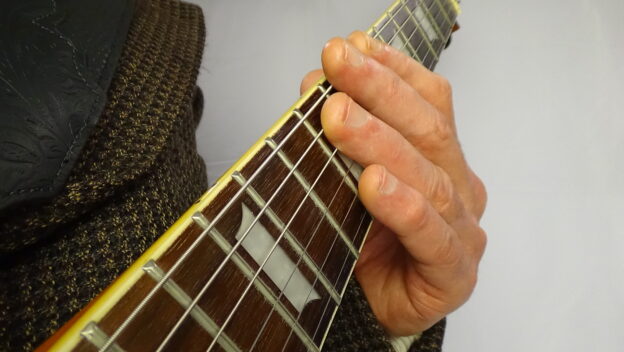
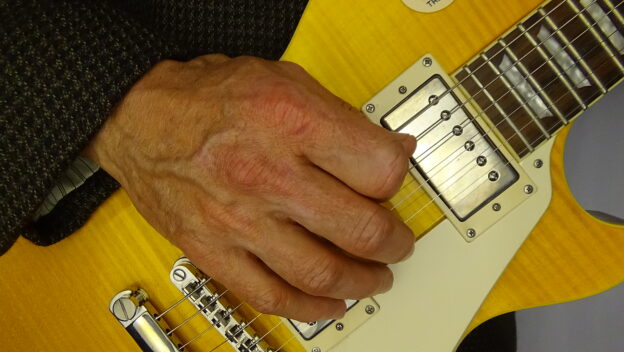
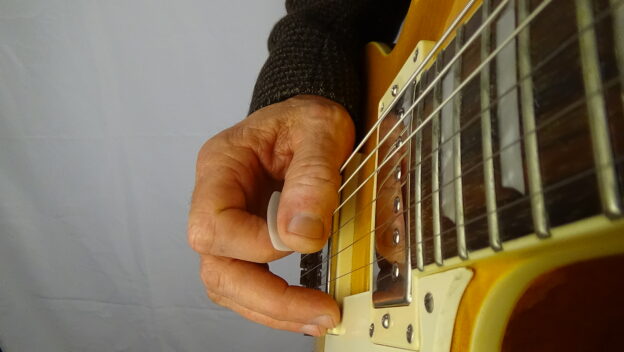
(4) Ultimately, we DO in fact have a great degree of control over individual fingers, but we must consciously choose to exert this control in defiance of the default programs. For example, I often see a tightly curled pinky when making fifth chords (power chords), and I always advise that this creates unnecessary tension, which further causes unnecessary levels of finger pressure and undue difficulties in changing from one fretboard location to another. I then advise to manual override the pinky popcorn shrimp of death while making the fifth chords. It is always a struggle at first, but I have yet to observe a student who can not eventually cultivate a new habit of keeping all the fingers straight and relaxed while executing fifth chords. Likewise, the pick hand technique always starts out with a sort of stabbing motion coming from pushing the index finger and thumb out from the side of the hand which is planted on the bridge, and then curling it back in to make the pick stroke – just like writing. With enough focused effort the student can defeat the writing program and develop a new autopilot mode of efficiently picking from the wrist, with the fingers immobile and the base of the hand planted on the guitar or strings. (See my pick technique video for in depth analysis)

Don’t let IT ruin your technique. IT is a formidable enemy at first, but by consciously choosing to control your fingers until they do what you want, you can send IT packing and make beautiful music instead. Get to work, and don’t stop until you get the desired results! 

Copyright © 2026 Palmetto Music Institute. All Rights Reserved.

Why Doing Your “Best” Is Not Enough

By Chad Crawford, PMI Guitar Instructor

Don’t sweat the small stuff! So goes the old saying, and within its sphere this is a sage piece of advice. When playing guitar the ability to cruise past mistakes without getting derailed is critical.  However, we need to keep in mind that playing guitar and practicing guitar are very different things. When practicing guitar we very much need to sweat the small stuff. Practice does not make perfect unless it is perfect practice! Repetition of slop guarantees playing slop. So when practicing we need to perform every detail of our technique as perfectly as possible. Of course “perfection” by its nature is not a realistic goal. The point is that we need to be continually striving to improve on the details of how we interact with the guitar. If we make “perfection” the target of our technique endeavors then our actual results will be far superior to those resulting from a vague goal like “doing the best I can”.

While doing our best is not a bad ideal, in practical application this kind of ambiguously defined goal leaves us a lot of room for actually not doing our best. If we measure doing our best solely by subjective criteria such as “this felt difficult so I must have been doing my best,” that is a well-intended but flawed yardstick by which to determine what is our best. Our best practice will result when we apply focused attention to the smallest details of our technique, measuring by objective criteria rather than by our perceptions of difficulty or success.

It is important to understand that people do not deliberately set out to practice in ways that are less than productive. Rather, focused concentration for extended periods is not our default mode of thinking, such that errors creep in just under our notice despite our general intent to “do our best”. So it is important to make a conscious effort to pay attention to the details!

Let us then look at some specific details of common technique flaws among students of guitar. Keep in mind, the goal of this discussion is constructive feedback toward the end of identifying problems and correcting them. Merely adopting the ideal that it is good to pay attention to detail will make no difference in your progress. You have to actually make the conscious effort to implement!

1 – Harsh Chord Changes: chord changes is one of toughest challenges for beginning guitar players. Just getting the fingers to work separately from one another at all is a full agenda. Once you get past this then the next step is to work on changing chords while keeping a rhythm pattern going. This is where the problem with attention to detail begins to show. Specifically, releasing tension on the last beat of the current chord in anticipation of the finger shifting for the next chord, such that the pick stroke yields a buzzy thud instead of a clear harmonious ringing. Most do not realize they are doing this until I point it out. Why? Because they have already shifted their focus off of the details of the current chord and onto the chord that is yet to happen. This is a perfect example of how lack of attention to detail results in undesirable results. If you want your chord rhythms to flow nicely so that they sound smooth then pay close attention to the last pick stroke of each chord and make sure you are retaining the fingering of the current chord until it is time to change. If this means you have to slow down to execute the chord change properly then do it. Speed up gradually as your muscle memory of the finger positioning allows it. 

2 – Choppy Scales: for scales to sound their best we need to play them with no time lapse between notes. This requires consistent finger pressure on each note until the precise moment of the change to the next note, and then a coordinated execution between the fret hand finger and the pick stroke as we shift to the new note. One common problem I observe is releasing pressure on the current note just as soon as the note is made. The cause is the same as the chord changing issue … preoccupation with the note ahead to the detriment of the one currently ringing. It is critical to pay attention to keeping the current note “live” while maneuvering both hands to set up the next note. Another common problem is lack of precise coordination between the two hands such that the pick strikes the string either before or after the placement of the fret hand finger on the upcoming note.  Again, both of these issues respond well to slowing down and paying attention to the details of your fingering and two hand synchronization, such that you execute notes well. Then after sufficient repetition to enforce the habits of hand, speed up gradually as your mastery allows while continuing to pay attention to these details. 

3 – Bends and Vibrato: bending along with its cousin vibrato are the most powerful, expressive techniques we have as guitarists – when they are executed well. They are also among the most difficult things to master since they are entirely under your control, unlike simply fingering a single note or chord where you have the frets to help you with pitch accuracy. The common problems I see with bending and vibrato are picking the string after the bend has started, bending up to an out of tune pitch, and then releasing the bend to a pitch other than the original unbent note. Again, these all respond well to slowing down and paying attention to the start, peak, and trough of the bend, then repeating until accurate bends become a habit while continuing to monitor the accuracy of peaks and troughs. Then speed up as improvements in muscle memory permit.

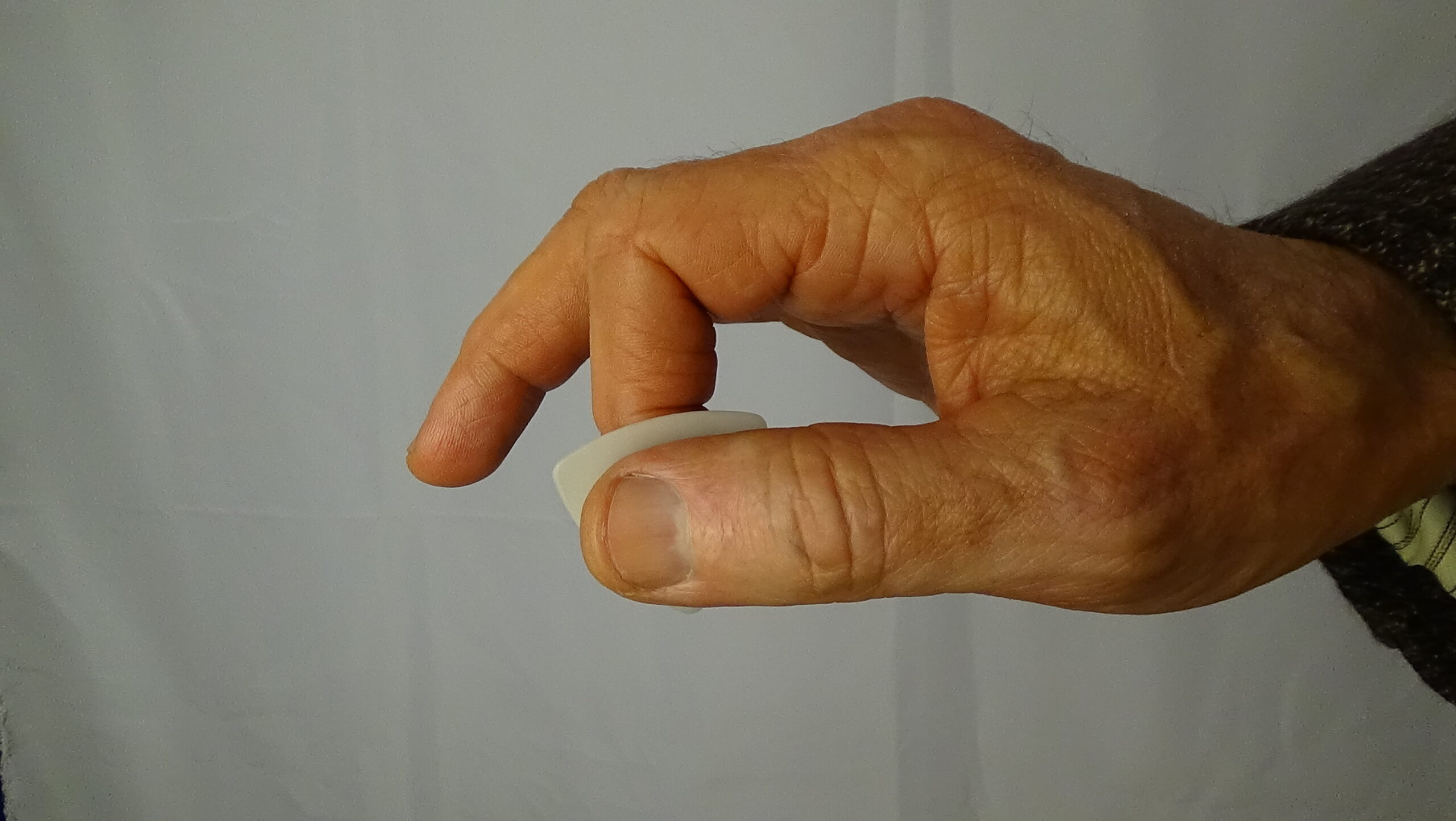
4 – Pick Hold & Orientation for Single Notes: the pick should be located between the pad of the thumb and the side of the forefinger, and the wrist should be relaxed such that the pick makes roughly a 30-45 degree angle to the strings. Then play with the base of the hand parallel to the strings, with a sharp but relaxed bump of the wrist to make the pick stroke. While this is physiologically the easiest, most comfortable way to hold and maneuver the pick, we tend to bring a lot of hangover from our handwriting habits into picking. This results in all manner of difficulties, such as bringing the middle finger into the pick hold, trying to pick from the far side of the hand (as with writing), and all manner of wasteful sweeping and swooshing motions where the job requires only a straightforward 1/4 inch arc of the pick. These handwriting habits are hard to break, but it is possible, and essential for fast and accurate picking. While practicing scales, pay attention to these details and force your pick hand to comply until it becomes a habit.

5 – Pick Hold & Orientation for Strumming: the pick hold is the same as for single notes. However, the pick stroke for strumming should come from the elbow, with the pick making a straight line across the strings. For the best tone we need light contact with the strings and a fast moving pick coming from a controlled flick of the wrist. Common problems with strumming are locking the wrist and then plowing harshly through the strings, trying to make an arc from the wrist rather then the elbow, and playing an arch or angle rather than a straight line parallel to the strings. Pay attention to these details for a smooth, chimey, shimmering tone from the strings while strumming.

6 – Excess Tension: this is a universal problem among beginner and even intermediate level guitarists. Playing with too much muscular power results in pressing fretted notes too hard, often bending them out of tune. A heavy handed pick attack results in notes and chords that sound harsh. Excessive muscular tension is an automatic nervous system response to physical challenge arising from our instinctive “fight or flight” mechanism. While this response is very useful when we encounter a bear in the woods, it is a disaster to our guitar technique. Playing guitar is a dance, not a fight. We must play with finesse, not power, if we want our guitars to yield up pleasing sounds in response to our manipulation. All of the problems above are at least partially a result of playing with excessive muscular tension. You can counter the fight or flight response with deliberate focused attention on the state of muscular tension in your hands, arms, and shoulders while practicing scales and chord rhythms. Make it a habit to play with as little muscular exertion as possible. 

Finally, be sure to practice as often as possible! Learning guitar is all about memory in terms of both mental recall and physical muscle control. Every day that you do not practice you lose a bit of recall and muscle memory. That is just the way the human machine functions and there is not much we can do about it. Therefore, it is best to practice every day. This is not feasible for many hobbyists. In this case, make it a point to practice more days than not … at least five days a week.

Pay attention to the details to ensure that your practice routine is leading to progress rather than frustration!

Copyright © 2005 Palmetto Music Institute. All Rights Reserved.

Guitar

Cracking The Creativity Code

By Chad Crawford, PMI Guitar Instructor

Among the challenges we face as developing guitar players, cultivating a sense of artistic creativity may seem among the most formidable. Many assume that creativity is a mysterious insight arising from the recesses of the fortunately gifted minds of a select few. In fact, creativity is not a mystery. As with all things musical it responds to focused effort to cultivate it.

So how do we get from having “no creativity” to the point of being able to write songs and play improvisational solos?

First let us address the occasional Mozart who shows up with tremendous innate musical ability. There is indeed a phenomenon of abundant natural talent, but for most musicians, other artists, engineers, inventors, writers, etc., natural talent is not the key to creativity. So then the Mozart types are irrelevant in terms of understanding how a person of typical native ability can develop creative prowess. Forget about natural talent, and most importantly don’t fall for the common misconception that creativity is something that you either have or do not have by inheritance.

Now let us consider what creativity actually is. Is it really assembling something out of nothing in a mysterious seizure of inspiration from quarters unknown? No! Even Mozart had to sit with paper and pen and work his inspirations into orderly, flowing pitch and time relationships. Consider this quote from prolific inventor Thomas Edison, whose record on creativity speaks for itself: “Genius is 1% inspiration and 99% perspiration”.

Creativity is neither an unknowable mystery, an accident, nor a fleeting peek into the ethereal mists. It is rather a predictable result of a process involving mastery of the fundamental elements of an endeavor, and then applying those fundamentals in such a way as to generate beauty of function and form. Notice that I did not say anything about creating something from nothing, or even something totally new. Creativity does not mean creating something from nothing. It means assembling the known into that which effectively solves problems or manifests beauty. It is well within the reach of anyone willing to apply themselves to the process. 

Now let us consider how this applies to music, and specifically to guitar. Music is fundamentally two objective phenomenon: pitch relationships and time relationships. Musicians assemble these relationships in such a way as to create the more subjective phenomenon of an emotionally satisfying flow of tension and release. This does not require the creation of anything new, but rather a well developed awareness of how pitch and time relationships work together to create a satisfying flow of tension and release.

So let’s break it down now even more specifically to the things we need to have mastery over in order to make music that satisfies ourselves and our intended audiences.

1. Know the notes on the fretboard – everything we do as musicians involves assembling notes in melody (one after another) or harmony (in unison, such as a chord or double stop) with reference to a tonal center (key). If you do not know the notes then you are limited to playing by patterns or by ear. While playing by patterns and by ear are useful tools, if you wish to cultivate maximum creativity then you need to allow yourself as many options as possible.  If you can visualize the letter names of the notes you are playing then it is much easier to choose resolving notes for phrases, or make useful alterations to chords to achieve just the right shade of mood.

2. Know the names of the notes in the Major Keys – the Major Scale is the starting point for all we do. Everything else is an alteration of some sort to a Major Scale. If you know the names of the notes in the key you are playing, and can also see them as you play them on the fretboard, these together will give you a great deal of power to achieve a desired musical effect without having to always guess your way through things with experimentation.

3. Understand Intervals – intervals are the building blocks of the pitch aspect of music. A thorough understanding of intervals will allow you to know what effect a note is going to have before you play it. If you know your intervals then you will be able to create musical effects at will, alter scales and chords to create precise shades of emotion, and transfer musical ideas from one key to another with ease.

4. Understand the effects of the basic divisions of the beat – along with pitch relationships, relative timing between pitch events is one of the fundamental components of music. A good set of timing relationships by itself is very powerful (think of a powerful drum intro that sets the mood for a song).  If you understand the basic divisions of the beat and how to modify them to tastes then you can create strong shades of mood at will.

5. Understand scale harmonization – knowing how to translate a particular scale into chord sequences will enable you to assemble pleasing chord progressions in a matter of moments. Knowing the chords in the key and the notes in the chords will also give you a lot of useful options for resolving solo phrases.

6. Listen to a lot of music – musical inspiration is often a residual effect of exposure to other music. Saturate your creative muse with immersion into a wide variety of music, and pay attention to the individual details such as the vocals, drums, and bass. In doing so you will cultivate a deeper intuitive understanding of music, much as a child learns to speak by regular exposure to speech.

7. Start from the known – creativity is often a matter of slight alterations to common ideas. Learn the signature licks, chord types and sequences, and rhythmic ideas of the masters of your preferred style. Then experiment with alterations until you uncover ideas that express what you wish. 

8. Constantly refine technique – if you have ever wondered how an accomplished guitarist can play something very simple and yet have it sound very beautiful and powerful, the trick is often in the technique. What many experience as a “lack of creativity” is in fact a lack of technique refinement that will make an otherwise great idea sound lifeless or even just plain bad. Technique development is not just a matter of mere repetition. It is essential to pay attention to the quality of sound (a.k.a. “tone”) during technique development practice. Don’t rush through technique exercises with the goal of merely getting them over with as quickly as possible. Listen carefully to the small details. Strive to improve the quality of sound resulting from each pick stroke.

This may seem like a hopeless lot to get done along the path to creativity. Bear in mind that learning music, including the creative aspect of it, is a journey. It is not needful to be “finished” with all other aspects of musicianship before experimenting with creative application of known musical elements. The point of this article is that creativity is a predictable result of identifiable methods, and therefore is accessible to all who are willing to work for it. Cultivate the appropriate knowledge, technique, and persistence, and then you can be sure that your creative muse will show itself!

Copyright © 2005 Palmetto Music Institute. All Rights Reserved.

Guitar Pick Hand Technique

Don’t Allow Instinct To Ruin Your Technique

By Chad Crawford, PMI Guitar Instructor

After a couple of decades of teaching guitar and interacting with other teachers and many clients, I can make a number of predictions on what any aspiring guitarist will struggle with and how the various responses to these stumbling blocks will either help or hinder progress.  The guitar is a challenging instrument, and there are any number of areas where one might encounter a temporary roadblock. Of these typical areas, there is one that stands out above all others as the number one barrier to progress: not following the instructions.

Allow me to clarify this concept since the phrase alone may seem too broad and actually contrary to your experience. I doubt you have ever openly refused to learn a particular chord, for example, or a basic scale pattern. This is not the sort of thing I mean when I suggest that a significant percentage of guitar students often stumble in implementing course recommendations. It is not a matter of people intentionally side-stepping the instructions. Rather it is that certain aspects of optimum physical technique run contrary to our instincts. Most students tackling a challenge in physical technique tend to unconsciously default back to instincts rather than consistently apply good technique recommendations. I am guilty of this as much as anyone, although I have improved significantly over the years in applying what the guitarist community has found to be the most effective technique development methods. 

Now let me narrow this down to the specific items that I see over and over. If any of these seem to apply to you, keep in mind that I am not writing about any specific person or experience, but rather my collective experience as a guitar student and teacher. Although some of these may apply to you, they are universal themes in the guitar community, so don’t feel like I’m singling you out for a hard time!

  1. Tickle the strings rather than tackle them.
  2. For playing chord rhythms, use a wide, fast, and light-contact pick stroke.
  3. For playing individual notes or muted two-string intervals (fifth chords, double stops) keep the pick hand palm turned into the guitar so that the pick moves parallel to the plane of the strings with a mere flick of the wrist.
  4. Apply no more pressure to the strings/frets than necessary to sound out a clear note.
  5. Avoid grasping the guitar neck with the palm and thumb as if it were a baseball bat.
  6. Use your elbow to change the working range of your pick – not your wrist or your shoulder.
  7. When changing to an upcoming chord, avoid chopping off the last beat of the previous chord by releasing pressure too early.
  8. Unless you are practicing specifically to develop speed, do not practice at a tempo faster than you can play with good note articulation and two-hand synchronization.
  9. When learning a new rhythm pattern, strum slowly and consciously count the beats and divisions of the beats, rather than trying to play the rhythm by “feel”. Once you have conscious mastery of the pattern only then should you work on keeping time by feel. 

If you have taken lessons with me for any length of time then you will know that I teach these things routinely, so you may wonder why I am taking up a Newsletter column with this routine lesson fare. There is a good reason I am emphasizing these things:  between knowing good technique and doing good technique, there is a subconscious barrier that we all struggle with: instinct. As your teacher, one of the most significant challenges I face in helping you develop your skills is your own instincts, such as using much more strength than is necessary, or handling the pick as if it is a plow. When attempting to play scale notes for the first time you will likely pull your other fingers way back from the fretboard. Then you have to slam the next finger down like a dive bomber in order to stay in time on the next note. This causes subtle delays that cap your top speed at limits far below your potential.

The first step in conquering these barriers is to be aware of these instinctive actions and over-reactions, so that you can be ready to spot them and counter with deliberate focused repetition of a balanced, optimum technique method that cooperates as far as possible with your natural physiology.  Then, apply focused attention to repetitions of good technique. Repetition of good technique results in habits, such that good technique becomes increasingly automatic, enabling to you to move between chords and notes accurately with little conscious effort.

Here is where the process breaks down: the focused repetition of good technique, and specifically the focus aspect. Your hands will constantly try to resort back to instinctive positions and motions, even though your conscious mind is well aware of these issues. You must pay close attention to these details of technique when you practice. This can be tedious at times, but the pay off is more than worth the effort!

Copyright © 2025 Palmetto Music Institute. All Rights Reserved.

Business Card

Firming the Foundations: Fix Your Focus

By Chad Crawford, PMI Guitar Instructor

Among the challenges we face as developing guitar players, retention of knowledge and technique is certainly high on the list. As with any long-term complex undertaking, we can take shorter or longer paths to the same end. While common sense dictates that we take the shorter path, there a number of ways to step off the shortest path without realizing it. For maximum results in the shortest possible time we need to be aware of these potential pitfalls and make every effort to avoid them.

A prevalent obstacle to maximum progress is lack of deliberate focus during lessons and practice. Repetition is a potentially powerful aid to recall and technique, but repetition without deliberate focus can actually cultivate less than optimal mental and physical habits and thus hinder progress. Contrarily, repetition combined with deliberate focus will enable your mind and hands to progress at their maximum rates.

It is important to understand that deliberate focus is not the default mode of the human mind. Our tendency is to let the attention wander around to different things, and thus sustained focus on one thing requires some conscious effort. Additionally there may be no feeling of increased progress while making the extra effort to stay focused, and so there may be no immediate sense of reward in exchange for the extra effort. However, both science and common sense reveal that all types of memory, including muscle memory, achieve their peak powers in response to sustained focused attention.

So, let’s look at some specific applications of deliberate focus in overcoming common pitfalls. It is not practical to attempt to cover every conceivable situation in which lack of focus will hinder progress but looking at a few examples will paint a clear picture of how this works. You will then need to use good judgment in applying the general idea toward finding specific tasks where lack of focus is holding you back.

1. Paying attention to instructions – it is very easy to allow the mind to wander off in the middle of an explanation, then practice something wrong all week. I have seen students so excited about learning something new that in the middle of my demonstration they take off trying to figure out what I am playing by ear rather than concentrating on the demonstration, which of course defeats the purpose of the demo. While I commend the passion about learning new things, this is an obvious example of not paying attention to the instructions, and the results are predictable – we have to go over it again. Whether the instruction method be a book, video, or personal one-on-one lessons, be assured that you will get better results by controlling the impulse to take off playing as soon as you have the first hint of where to put your fingers and instead work on getting your mind around the full explanation before attempting to apply it.

2. Following the instructions – assuming you have paid attention to the instructions and thus have a sufficient understanding of what to do, the next step is to apply the instructions. Certain details of optimum physical technique are often at conflict with our natural inclination toward doing what feels physically easiest for us at the moment. While few would argue whether or not following the instructions is important, some aspects of our motor skills operate at a subconscious level. While attempting scale exercises for instance, we must manage a number of things simultaneously such as note location, timing, and coordination of the picking and fretting hands. It is very easy in this kind of multi-tasking situation to allow the fingers to revert to auto-pilot while we monitor other details, and then we slip into repeating poor physical technique and allow it to become a self-defeating habit. It is very hard to break ingrained poor physical technique habits. Do not allow this to happen. Follow the instructions!

3. Frustration – nothing will derail your focus faster than allowing the feeling of frustration to take over your consciousness. This is a certain path to lagging progress, which leads to more frustration, and so it becomes a cycle of self-sabotage. Don’t let it happen. Assuming you are following a good program of instruction and are actually following the instructions accurately, indulging frustration is a waste of your time and effort. Do not allow frustration to become your measuring line of how well you are doing. Frustration is a typical human response to any complex endeavor, and it does not necessarily mean you are doing things wrong. If you know you are working on what you are supposed to be working on to reach your goals, then when you feel frustrated you should put it aside and stay focused on what you are working on instead.

4. Timing – while learning to apply new scales or develop efficient chord changes, it is common to focus on simply getting the finger motions done to neglect of the critical timing details that make these things sound clear and smooth so that you achieve a good sense of musical flow. Pay attention that each note of a solo gets a clear pick stroke and “airtime”. Stay focused on matching your notes up to the underlying beat. Make sure that you are continually pushing yourself for faster chord changing so that each pick stroke of your chords is clear, rather than chopping off the last pick stroke of a chord just before the chord change. That is a lot to manage simultaneously, but it will get easier with time and repetition until you can do it automatically. In the interim, stay focused on timing!

5. Speed/overplaying – beginner to intermediate level guitar players often show a tendency during solos toward filling every perception of space with as many notes as possible. While an intelligently executed run of sixteenth note triplets can add a lot of intensity to a solo, this is not the same phenomenon as simply blasting every bit of space with a battery of memorized scale patterns. While soloing you should be focused on timing, note articulation, and creating a sense of tension and release that complements the chord progression. Do not allow yourself to fall into mindless ripping of scale patterns. Blasting scale patterns at top speed is practice, not playing! When playing you should focus on the flow of tension and release so that you are saying something with your music rather than simply showing off your mastery of scale patterns.

Keep in mind … focus is a choice rather than a “talent”. You will never develop a mental habit of deliberate focus without determined effort to make it so. It does get easier with time and repetition, so get started today looking for deficiencies in your level of focus. The results will be worth the effort!

Copyright © 2005 Palmetto Music Institute. All Rights Reserved.

Guitar Lessons Greenville

Stop Playing Guitar!

by Chad Crawford, PMI Guitar Instructor

Practicing guitar and playing guitar are not the same thing, and it is important to understand the difference if we want to maximize our progress.  While playing guitar is the end game of practicing, and we need to spend plenty of time playing, practicing is the means to the end of playing. It is essential to practice well and not allow playing to take over during what should be practice time. Although this may seem obvious on the surface, it is very easy to drift over into playing while trying to practice. Here we will look at the differences and consider how to avoid this pitfall.  

So let us consider the differences between the two and how to avoid mixing them up. Playing guitar is the broad application of all our knowledge and technique skills into making music. Practicing guitar is deliberate focus on a narrow range of knowledge and technique skills with the specific goal of cultivating improvement in those specific areas. While playing, we focus on all that we can do. While practicing we focus on what we can not yet do, or do as well as we would prefer.

Here are some measures to avoid getting stuck in a rut by playing through practice time:

1. Consider where you are, where you need to be, and how to get there – if you have no master plan for reaching your musical goals then you can be sure that your practice time will consist of merely playing what you already know rather than making specific improvements in those things that will allow you access to the next musical level. To devise a master plan you should look to the music you wish to play and find out what kinds of chords, rhythms, scales/arpeggios, and techniques arise in that music. Focus on those things in order to play that kind of music.

2. Define goals for every practice session – if you practice with no particular goal in mind then you will get exactly where you planned to get – nowhere. In every practice session have a plan to work on improving specific aspects of knowledge and technique according to your overall master plan. Committing your plan to paper will aid greatly in keeping it in view during practice.

3. Focus on specific aspects of knowledge and technique during practice – when you are for instance practicing the scales you need for your preferred musical style, focus specifically on timing, note articulation, resolving notes, technique (relaxed fingers!), two hand synchronization, and eventually speed. You may have to break these goals down across several practice sessions per week so that you can devote adequate time and attention to each. Playing licks that you already know, or mindlessly wandering up and down through scales, is not practice. That is playing and it will not help you improve nearly as much as practicing. 

4. Push yourself to do better than yesterday – profitable practice does not come from merely repeating what you did yesterday. It comes from making it a point to do better than you did yesterday. Doing better than you did yesterday does not come from merely accepting the vague proposition that you will try do better today then you did yesterday. It comes from focused attention to the minute details of your playing, such as striving for better note articulation of scales, faster chord changes, or deliberately playing with less overall muscular tension than yesterday.

5. Maintain your attention on the details – it is very easy to allow the attention to wander off during doing repetitive aspects of a practice routine. Focus yields much greater results, and focus is an ongoing choice because the mind tends strongly toward wandering off from one thing to another. Choose to keep your mind focused on the details of what you are working on!

6. Include some playing time in your musical endeavors – it is pointless to pursue music if it is going to mean nothing but practice. Allow yourself some time within each practice session, or a few times a week if that works better for you, to just play without being overly concerned about the perfection of the details. Perfect the details during practice, and then relax and let your hands do their thing when you play. During playing time, do whatever is the best you can do and don’t allow mistakes to rob your enjoyment of it. Just play and enjoy what comes out well. As you progress through diligent practice, you will find that your playing includes increasingly fewer mistakes and more enjoyment. It is a process. Give it time.

Copyright © 2005 Palmetto Music Institute. All Rights Reserved.

P-Bass

Can’t Remember Where You Left Your Memory?

By Chad Crawford, PMI Guitar Instructor

One of the greatest areas of struggle for most guitarists is remembering the numerous chords, scales, chord progressions, and other odds and ends that we must employ to reproduce our favorite songs or to improvise. While there is no way to make memorization of large amounts of information easy, there are things we can do to make it more predictable and consistent and thus produce better results and faster progress in our playing.

Psychologists advise that lifestyle greatly affects memory. While this article is specifically directed at musical pursuits rather than memory in general, it is worth mentioning that a healthy diet, regular exercise, and adequate sleep allow our memories to function at their maximum potential. If you want the best results from your musical endeavors, take good care of yourself!

For musicians, we need to focus specifically on two components of memory: procedural memory and declarative memory. Procedural memory, for our purposes, refers to that aspect of recall pertaining to executing physical tasks. In musician lingo we often refer to this as muscle memory. Declarative memory is that aspect of memory that allows us to recall facts and figures, such as chord shapes, scale patterns, and the intervals of the root notes of chord progressions. So now that we have a view of the two aspects of memory we need to master, let’s look at some specific strategies.

Improving Muscle Memory

  1. Repetition – there is no substitute for repetition. You may have heard something of the old adage among guitar players about “playing until my fingers bleed”. While this may sound like a ridiculous hyperbole, I have in fact literally practiced extreme bends for certain licks to the point that one of my fingernails began to separate from the nail bed and seep blood. While I don’t recommend this, it does illustrate the point that repetition is the key to muscle memory. The more you repeat good executions of a given technique, the better you will play it. This is also incidentally one of the keys to overcoming “stage fright” – embed your skills so deeply into your muscle memory that you can execute them accurately regardless of any distractions.
  • Consistencyyou will get much better results from your muscle memory by practicing a moderate amount of repetition daily as opposed to trying to cram in a large block of repetitions on the weekend or the day before your next lesson!
  • Focus – repetition of slop leads to playing slop. It is extremely important to pay attention when practicing scales, for instance. Be sure that you are relaxed and using the most efficient motions possible for each note. When you are learning something new it is important to practice it at a speed that will allow you to play it accurately and efficiently. That often means “excruciatingly slow”. If that is what it means then do it that way. You will never have speed without slop until you thoroughly train your muscle memory to execute the required motions as efficiently and accurately as possible. Then gradually increase speed, maintaining a balance between speed and accurate execution.
  • Test – it is critical that you push the limits of your muscle memory by testing it routinely. Once you have learned a scale pattern then work on playing through it without looking at your fret hand fingers. Likewise, once you have learned a new chord then get started with applying the chord in a chord progression without looking at your fretting hand. Observe mistakes, correct them, and repeat. This will greatly increase your speed in mastering technique.

Improving Recall

  1. Focus – as with muscle memory, focused attention on the details of new information will greatly increase your ability to recall that information. While this may seem obvious, it is important to be aware that we all have a tendency to allow our thoughts to drift randomly. For maximum understanding and recall it is imperative to willfully interrupt the random flow of thought and focus your attention while trying to digest new information.
  • Focus – see item 1. This is so important that I am repeating it to help you remember it!
  • Relation – as often as possible, try to relate new information to things that you already know. For instance, if you know the first position A Major chord shape then it is not so difficult to recall that the A7 is simply A Major minus the middle note. Likewise, all of the A form bar chords are an offshoot of the A Major chord shape, so if you know the A Major well enough then the various bar forms are not so hard to remember.
  • Isolation – break complicated sets of information into parts and memorize the individual parts first, then assemble them into the complete set. For instance, with a new scale pattern memorize the notes on two strings. Then move to the next pair of strings, then the next. Then go back and put them all together into the complete pattern. For a tablature score, learn one line. Then move to the next and learn that one. Then play the two together. Then learn the next line, and then add that to previous two. Repeat until the song is complete. Then repeat until your fingers bleed!
  •  Consistency – as with muscle memory, recall responds well to repeated exposure to the same information. This is why it is much more productive to practice a half hour a day than to run practice marathons on the weekends.
  • Vocalize – where feasible, find some way to say out loud what you are trying to memorize. Speaking things aids the memory in storing them. Example: when trying to memorize notes along the fretboard, say the notes out loud as you are playing them. This will greatly speed up your ability to recall the names of the notes.

Following these recommendations will greatly increase the rate of speed of your mastery of all things guitar. We all struggle with memory, but these strategies will assist you in increasing the rate at which you conquer various elements of musicianship. Remember this: never give up!

Copyright © 2025 Palmetto Music Institute

Guitar Technique

Seizing Upon the Power of Habit

By Chad Crawford, PMI Guitar Instructor

Aspiring guitarists grapple with a number of challenges in perfecting the craft. From memory failure to reluctant hands, we all struggle with predictable challenges. Some of these issues are inherent flaws in the human machine about which we can do little. Others are more within the realm of our choosing, and choose well we must if we wish to have the best possible results for our efforts.

Among the numerous assets we have to help us overcome barriers to progress, none is more potent than the power of habit. Mastering the guitar is very much a matter of cultivating good habits, both mentally and physically. Contrarily, allowing bad habits to persist will torpedo our efforts. Unfortunately, the default setting of the human machine is toward counterproductive habits. Alternatively, through exercise of our will we may choose to cultivate good habits that support musical excellence. So we must persist in a productive practice routine with various repetitive mental and physical exercises such that basic skills like chord changes, scales, and rhythm patterns become habitual. Once these things become habitual then we can then keep them habitual with only a bit of routine maintenance, and then we are free to focus on the more exciting and gratifying subtleties of making good music.

So let’s take a look at a list of techniques and strategies that will assist in cultivating good habits. These are not randomly selected tidbits, but rather key areas of fundamental knowledge and technique where I observe students struggling time after time. You can use the power of habit to help you get these fundamentals out of the way as soon as possible so that you can move on to more interesting things.

  1. Practice Scheduling – set up a designated place where you will practice. Keep your guitar handy on a stand and your practice materials and metronome already out or readily accessible. Make an effort to practice at the same time of day as much as possible so that it becomes a habit, where you then feel uncomfortable if you don’t get started at the appointed time.
  • Fretboard Note Recognition – set aside some time each time you practice to target some area of the fretboard for note memorization. Break this formidable task into small chunks according to various schemes of dividing the fretboard such as notes along one string, one fret, etc. Make it a habit to memorize the notes along any one such scheme every week.
  • Chord Changes – changing chords quickly and accurately is the most significant barrier that beginning students struggle with, and one of the more frustrating. It is one of the keys to making really satisfying music, so it is important to get this under control as quickly as possible. Many students tend to develop a habit of pausing the rhythm at chord changes and allowing themselves ample time to change chords. While this is impossible to get around at first, it quickly becomes a habit that persists long after the student is actually able to change chords without losing time. Avoid this trap by always making the effort to target the first beat of a measure for having your chord change complete. Be there on the 1 count!
  • Chord Strumming Technique – while focusing on changing chords, many fall prey to a weak pick attack consisting of a half-hearted push of the pick through the strings along with a short pick stroke. Cultivate a habit of starting each down stroke at the top of the guitar body and follow through to the other side of the guitar body. Then reverse this for the upstroke. Do not push the pick through the strings as this sounds harsh and unpleasant. Perform the pick stroke with a lively snatch of the forearm, allowing the relaxed hand/wrist to follow along, and thus drag the pick quickly and lightly along the top of the strings. This is not going to happen by accident. Force it until it becomes automatic.
  • Playing Scales with a Legato Feel – when practicing scale patterns always allow the previous note to run into the next note with no silence in between. This means you must maintain pressure on the previous note and snap your fingertip onto the upcoming note while simultaneously making the pick stroke for the new note. Pay attention to this important detail and keep paying attention to it until it becomes a good habit!
  • Playing Phrases in Time – to get started with solo phrasing, always play your scale notes on the beat and resolve on the first beat of the underlying chord change. This may be obvious to the mind, but getting the fingers to cooperate does not happen automatically. It is very easy and very common to get absorbed with fingering notes and lose track of the timing. Make it a habit to pay attention to the beat while phrasing, and play your notes on beat.

Habits can work for you or against you. Ensure that they work for you by diligently following the tips above every time you practice. Cultivating good habits will greatly increase your rate of progress.

Copyright © 2025 Palmetto Music Institute. All Rights Reserved.

Guitar Pick Hold

Best Practices for Practice

By Chad Crawford, Guitar Instructor Greenville Guitar Lessons by PMI

If you have been playing guitar for any length of time then you know by now that the one supreme key to results is this: practice! However, it is possible to practice routinely and still get poor results. How is this? It is by practicing the wrong things, in the wrong order, and in the wrong way.

So how can you know what to practice, what order to practice it in, and how to practice for maximum results? Follow the recommendations below to make the most of your practice time.

What to practice:

(1) Playing guitar is a complex combination of mental and physical skills. In order to master the subject we need to break it down into manageable pieces. What specifically to practice is too big of a subject for a short article. However, what we can do here is narrow down the possibilities. The most important thing you need to consider is your goals. If your goal is too generalized it will not help you nail down what you need to practice. For instance, if you set an overly broad goal such as, “I just want to be able to play guitar,” this is not going to help you identify what information you need to learn and what techniques you need to master. If you are not sure about your goals then you should give some thought to what kind of music you like to listen to. Then you must identify what you must learn to do to mimic this kind of music. Those are the things that you need to practice. Make a list of those things and then go to work on them every time you practice. Do not get bogged down in practicing one technique or one song. Practice a variety of things pertinent to your goals.

(2) A common problem I see among aspiring guitarists is the tendency to want to know and master everything about guitar. While the idea is not a bad one in theory, the reality is that music has been under development for several thousand years. It is a huge subject. Some universities offer doctorate level programs in music. As a hobbyist you do not have time to master “everything” about guitar. You are going to have enough on your hands pursue fluency in one style and play passingly well in two or three related styles. So don’t waste your time learning exotic scales and chords if your intent is to play popular radio songs. Learning obscure modes is not going to make you a better player if you are still struggling with applying the pentatonic scales. Master the basic chords, scales, and techniques and then work on applying them effectively. Once you have reached a level that you can enjoy playing the basics then it is time to work on the more complicated stuff, and then only if it is applicable to your goals at that point.

(3) At the other extreme is the tendency to want to learn only bare minimum requirements for playing specific songs. There is a bit of controversy in the guitar teaching community as to whether learning specific songs is an ideal method. I think learning songs can be very helpful to mastering knowledge and techniques on the condition that the songs are incorporated into a balanced program of learning music in general rather than just learning the bare minimum information and techniques to play the specific songs. Taken by itself, learning songs is a dead end that leaves many aspiring guitarists frustrated and burned out. Don’t let this happen to you!

How to practice:

(1) One of the recurring problems I see with students of guitar is the tendency to get into a self-defeating routine with practice. It is not that a practice routine itself is problematic. Practice certainly does need to be a routine undertaking. The problem develops in that practicing specific exercises becomes a matter of mindlessly running through the same material with no specific mental focus on improvement. Practice becomes an exercise in repeating the same stuff from yesterday in the same way. This is the number one issue I see that impedes progress. When you practice any skill, it is important that you focus on doing it better today than yesterday. Whether it be memorizing some chord, scale, or song, or improving the speed or finesse of chord changes or scales, it is important to push yourself to make an increment of progress every time you practice something!

(2) Another common problem is the tendency to rush through practice. While speed is essential in executing chord changes and phrases, you must balance speed with accuracy. Rushing through every exercise as fast as possible will only delay your progress. Make the effort to ensure that your execution is accurate as well as fast. This often means that you will have to slow something down to a tempo that may be completely unrealistic for actual playing and then practice at that speed until you can execute the technique fairly well. Then gradually increase speed as you are able.

(3) Finally, be sure to practice as often as possible! Learning guitar is all about memory in terms of both mental recall and physical muscle control. Every day that you do not practice you lose a bit of recall and muscle memory. That is just the way the human machine functions and there is not much we can do about it. Therefore, it would be best to practice every single day. However, this is not feasible for many hobbyists. In this case, make it a point to practice more days than not … at least four days a week.

Follow these guidelines to ensure that your practice routine is leading to progress rather than frustration!

Copyright © 2005 Palmetto Music Institute. All Rights Reserved.